I’ve been resisting following the Ghomeshi trial. Partly, I’m enabled by circumstance–a temporary fragility of anato Continue reading
To Follow or Not; Paying Attention to the Ghomeshi Trial
Reply
I’ve been resisting following the Ghomeshi trial. Partly, I’m enabled by circumstance–a temporary fragility of anato Continue reading
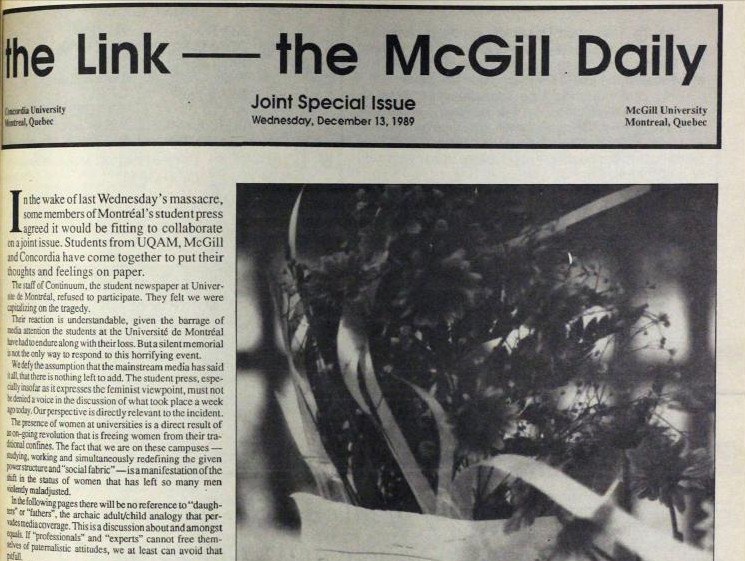
26 years ago today; I was pregnant, happy, optimistic for my child, who was being born into a world that had just breached the Berlin Wall. It seemed like peace was breaking out all over. And then, Dec 6. Montreal. L’Ecole Polytechnic.
It was a terrible shock. Not just that a single shooter would attack students at a university. But that he would specifically order classes to separate into groups of male and female, and then shoot, murder, slaughter, the women only. And then repeat in other classes.
Suddenly, the entire nation, was confronted with a terrible truth: as people listened to the reports, some realized they’d expected -and accepted- the idea that the shooter might separate the victims by sex, so that he could shoot the men. That he targeted the woman was a surprise, an affront.
The tragedy of L’Ecole Polytechnic gave Canadians a double shock: We realized our attitudes to violence had been blunted by patriarchal assumptions that included the horrid acceptance that males were legitimate targets for violence. Equally, our understanding of violence against women had been dismally, willfully, complicitly, naive. The value of feminism as a necessity, even as it was being described as the murderer’s motivation, was confirmed. The optimism of Berlin was washed in the horrors, the guilty insights, of Montreal. 22 days later, I gave birth to a daughter.
Now, 26 years on, we have raised the approbation of Violence Against Women to iconic, professionalized status. It is possible to use the acronym of VAW and be widely understood as one condemns patriarchy, the ubiquitous and resilient inequities between sexes, and argues for services, policies, legislation, education to mitigate VAW. Good steps have been taken. But not enough.
The acceptance of violence itself has not moved on much from the guilty horror of 1986, and mothers’ children continue to be slaughtered. Today, as every Dec 6, I condemn the craven decisions that permit the means for violence; I mourn for those mothers who suffer the catastrophe of violence against their child, and offer a grateful whew to the luck goddess that I am not in their cohort.
Dec 7 2009
It has been a tense week in Madang town. The response to the brutal home invasion, rape and torture of a woman who has been a pillar of the community for decades has been shock, anger and deep sadness. One of the few women in PNG to receive an OBE, Madang’s only “Dame” has contributed so much to the people of Madang Province. From hospital beds to rural school supplies to children’s education to support for the fledgling Provincial AIDS Committee, she has been there for Papua New Guineans. Now a rather frail, yet feisty septuagenarian, the lady was an easy target for the hooligans known to be living in the Provincial Health Department’s compound near her home. The same thugs are suspected to have assaulted the Fred Hollow’s Eye Clinic Physician a few months ago, while he was on duty in the hospital. In this same week, other women in Madang have been raped or murdered, and this form of violence against women has been increasing over the past two years. The fact that this latest attack was against someone who has done so much for the people has brought the escalation of violence, and in particular violence against women, to the forefront of public attention. It has also made the international NGOs reconsider their position on being in Madang, and whether they should bring female staff or volunteers to Madang. Fred Hollows evacuated their staff. It is unclear when – or if – they will return to reopen Madang’s eye clinic.
Women’s groups, local politicians and grassroots ‘mamas’ and ‘papas’ mobilised to demand stronger support from the provincial administration. A protest was planned for this morning (Monday Dec 7’09), to march from Bates Oval in the centre of Madang town, to the Provincial Assembly. Late Sunday night, rumours and sms messages circulated, saying that the protest was to be postponed until Thursday afternoon. Consequently, this morning, many of us stayed home. We grumbled that changing the plan for a popular protest was a great way to dilute the action and weaken the need for government response. However, many Madang-ites did not hear that rumour. They showed up in force at Bates Oval and decided to hold the march anyway. As soon as news spread that the protest march was on, I jumped in a vehicle with Nancy Sullivan and we raced toward the marchers. We arrived just as they were parading around the Assembly grounds, yelling “no more rape!” The governor Sir Arnold Amet, Provincial Administrator Joseph Dorpar and two members of Parliament, Ken Fairweather and John Hickey were ready to listen to the crowd, and receive a petition. For the first hour, various women and men spoke, using a loud hailer. Women described being shot by their husbands, of having a child murdered. They reminded the crown and the politicians that women were the fundamental basis of the family, the community and life itself. We could not stay long enough to hear if people got around to calling for better community policing, more justice, and peace, as I hope they did.
The results of the protest are as yet unclear. But the mood of the crowd was not. People are clear that Enough is Enough. Handmade signs called on men to recognise that their son’s behaviour was modelled on their own, and that women deserved respect. This may be Madang’s first popular protest against violence against women. Meanwhile, the woman who was attacked is under medical care in her home, suffering the side affects from post-exposure prophylaxis against STIs, HIV, and the multiple physical injuries she suffered at the hands of men who local people are referring to as “the animals”.
For more commentary see:
www.messersmith.name/wordpress
and
www.nancysullivan.typepad.com/
photos I took with my iphone:
 Ethnographer|Ecographer