CBC Cross-country Checkup asked Canadians what we thought of Trump’s 51st state comments. Here’s what I said, before “ElbowsUp” was a thing. And what I missed.

A few months ago, CBC radio’s flagship national program called Cross-country Checkup asked Canadians a question that riled us immensely. I’m posting in September of 2025, a letter I wrote to Ian Hanomansing back then. Barely nine months, one election, one by-election a G7 summit, and multiple White House performance art shlocks later, amid a worsened geopolitical situation in which Trump has proved himself simultaneously impotent (at deals, peacemaking) yet virulent (to liberal human rights), and some of my concerns seem now to be already normalized, subsumed under the tsunami of Trumplandia authoritarianism.

In only nine months, we have fewer made-in-USA goods on our grocery store shelves, and more products Made in Canada or imported from Mexico, South Africa, or elsewhere -anywhere but USA. We have Canadians eschewing travel to, or even through, the USA. We have legislators rushing to remove barriers to intra provincial trade. We have a macro economics expert as the Prime Minister and we have started to talk about diversifying our economic partners away from the USA.

But we also have a Prime Minister who, despite calling himself a Liberal and plying us with hockey metaphors and Dad jokes, is acting like a conservative, gainsaying important progress our nation was beginning to make in terms of the TRC Calls to Action, Indigenous reconciliation, pivoting our natural resource-based economy away from petroculture and towards a more environmentally responsible system, and ensuring gender-based equity and labour rights. Further, we have started to think about ourselves as a war hawk nation as opposed to a peacekeeper nation.

I certainly did not see those threats coming when I responded to Cross-country Checkup’s query about Trump’s attacks on our sovereignty.

Here’s the letter:

Feb 24’25

To: checkup@cbc.ca, ian.hanomansing@cbc.ca

My name is Heather, I live in Edmonton. I work in higher education, supporting research. Before that I managed international development projects, some of which were using USAID or PEPFAR funding. And before that I was a professor at a university in the United States. I say this to give context and to show that I am fairly well informed on our neighbours to the south.

What do I think of Trump’s comments about Canada becoming the 51st state?

I think it’s a damn good thing Cross-Country Check up modified the question from what you originally proposed!!  Because your original concept was an absolute normalization of the idea of the USA invading Canada, or annexing Canada economically and politically. This was a shameful example of how the CBC has ceased to be a dependable Canadian agency representing the voice of Canadians. The last thing Canadians need, is to pretend to be neutral while giving the Trump regime an edge to justify their desire to exploit Canadian resources and pervert Canadian democracy by any means they wish.

So: What do I think of Trump’s comments? I think they’re insulting,  offensive, and a rejection of 80 years of international law not to mention numerous treaties. It is very clear these are no longer friends or neighbours to be trusted.

I also think it  means Trump has done Canada, including our economy, a *favour*. For too long, we have had businesses look to the easier route to profit south rather than invest in east-west and south-north supply chains and product development. Yes, the US, via several trade relationships such as the AutoPact and then after that NAFTA and USCMA, was a source of wealth for many, but it was at the expense of Canadian jobs and most especially of ties of solidarity within our own country. But now, thanks to Trump’s insulting mouth (and our knowledge that he has an approximately 45% approval rating), more and more Canadians are paying attention to artisans and retailers and grocers producing in Canada. We are buying Product of, or Made in Canada, shopping local, and we are sharing lists of businesses across the provinces. We are addressing interprovincial trade barriers and also looking to diversify our balances of trade, including joining the EU.

I think that’s good for Canadians, and good for Canadian Confederation. While there will be short-term pain, it will give us long-term gain: better internal solidarity, self-sufficiency, and stronger domestic ties plus a more diverse corps of international trade and political partners.

So, on this, the anniversary of Putin’s 2020 invasion of Ukraine (and the 2014 one too), I think that Canadians — especially our elected leaders and our federal and provincial agencies’ civil servants — should be paying very close attention to what Trump is doing and has done, and we should be afraid.

He is dismantling all of the institutions which could block an authoritarian dictatorship:

•He has stacked and intimidated the federal and state judiciaries.
•He is culling the military intelligentsia and those who will abide by the rule of law.
•He is planning to raid the endowments of the major universities.
•He has dramatically decapitated and dismembered numerous Federal agencies by firing the civil servants. And
•He is tearing up all the international climate change commitments and opportunities for saving the planet.

These are all actions which have precedents in history, from Henry VII (who raided the monasteries of their wealth so as to prevent them from blocking his political manoeuvers), to Joseph Stalin (who purged his military prior to forced land collectivization and starvation of the peasantry — in Ukraine), to successive Chinese emperors (who always disposed of all the bureaucrats from the prior rulers), and Romans and Nazis who destroyed fertile lands rather than let someone else use them.

Trump is dismantling all the checks and balances, all the system structures which theoretically could block his manœuvers.

What remains of American bureaucracy, judiciary, civil institutions, in the next few months will either be gone or so  overwhelmed, or too MAGA-corrupted as to be unable to be allies to Canada. What remains will do nothing to respect or protect Canadian –or any other nations’– sovereignty. He has already demonstrated that in Palestine and Ukraine (and pretty soon he’ll do it in Taiwan and maybe South Korea).

This goes beyond the threat of tariffs or the opening forays in a trade negotiation. My fear is that without strong immediate action, eventually the US will buy or coerce control of Canadian mineral, water and people resources, his regime will skew our elections, and turn our citizenry into underpaid and underserved peons. We will be like Ukrainians are today, fighting to protect Canadian culture, history, lands, economy, sovereignty.

Trump’s 51st State threats make me think we have to reinforce our internal bonds and external boundaries, and we have to do it knowing that there is a tiny portion of quislings and seditionists in our country. Many of them live in my province of Alberta.

🇨🇦HyL

—-

Now, mid-September, after a summer laden with heat waves and wildfires, our government is reversing direction on climate-change prevention. As the PM said “the auto sector have enough on their plate right now”, so the minimum requirements for producing a vehicles are being postponed. To which I want to reply: you know who have “enough on their plate right now”? Atlantic cod, beluga, black ash trees, bumblebees, caribou, goldenseal, monarch butterflies, narwhal, otters, salmon, white lady’s slipper orchids, wolverines… (all endangered); plus all of us who want to breathe clean air, drink clean water, and not die guilty of catastrophic species and biodiversity loss.

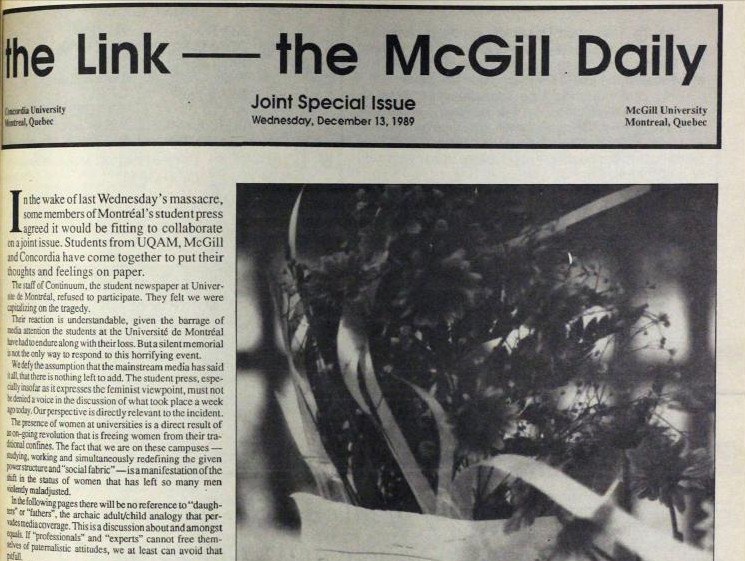
December 6, 1986 & 2015: The Resilience of Violence

26 years ago today; I was pregnant, happy, optimistic for my child, who was being born into a world that had just breached the Berlin Wall. It seemed like peace was breaking out all over. And then, Dec 6. Montreal. L’Ecole Polytechnic.

It was a terrible shock. Not just that a single shooter would attack students at a university. But that he would specifically order classes to separate into groups of male and female, and then shoot, murder, slaughter, the women only. And then repeat in other classes.

Suddenly, the entire nation, was confronted with a terrible truth: as people listened to the reports, some realized they’d expected -and accepted- the idea that the shooter might separate the victims by sex, so that he could shoot the men. That he targeted the woman was a surprise, an affront.

The tragedy of L’Ecole Polytechnic gave Canadians a double shock: We realized our attitudes to violence had been blunted by patriarchal assumptions that included the horrid acceptance that males were legitimate targets for violence. Equally, our understanding of violence against women had been dismally, willfully, complicitly, naive. The value of feminism as a necessity, even as it was being described as the murderer’s motivation, was confirmed.  The optimism of Berlin was washed in the horrors, the guilty insights, of Montreal. 22 days later, I gave birth to a daughter.

Now, 26 years on, we have raised the approbation of Violence Against Women to iconic, professionalized status. It is possible to use the acronym of VAW and be widely understood as one condemns patriarchy, the ubiquitous and resilient inequities between sexes, and argues for services, policies, legislation, education to mitigate VAW. Good steps have been taken. But not enough.

The acceptance of violence itself has not moved on much from the guilty horror of 1986, and mothers’ children continue to be slaughtered. Today, as every Dec 6, I condemn the craven decisions that permit the means for violence; I mourn for those mothers who suffer the catastrophe of violence against their child, and offer a grateful whew to the luck goddess that I am not in their cohort.

Pauvre Paris. Reflections in the aftermath of November 13, 2015

When I lived in Paris (1986), young Algerians, especially men, were the most despised members of the city’s society. They hung out, smoking cigarettes on streets and trying to chat up girls in public plazas like Trocadero because what else could they do? No one would hire them. Neighbourhoods like Clichy, where the North and Central African immigrant population was high, were scary and considered unsafe at night, in the same way that parts of New York City at around the same time were considered dangerous at night. I was warned to avoid the Algerian men because they might be pickpockets, and to ignore (“don’t encourage”) the ‘gypsies’ –Arabic speaking women begging outside banks and in the Metro. Nevertheless, I saw many people gave them cash, and many of us living there participated in anti-racism events, just as much as we visited galleries and museums and bookstore-cafes. It was a complicated, beautiful, confusing, compelling place. Most certainly a Moveable Feast, as Hemmingway called it, Paris has continued to nourish me ever since.

When I was last in France (2013), in the south the contrast between communities like Arles, Aix and Orange, and Beziers and Marseilles was striking: The local economy was clearly suffering. It was palpable where the Front National and Marine LePen were strong, and where those of Algerian/North African (multi-generational) ethnicity were discriminated against. It reminded me at the time of the work of anthropologist Ann Laura Stoler, who wrote about the rise of French fascism in the south of France, and of French sociologist Pierre Bourdieu, who studied both post-war Algeria and French notions of identity and ‘distinctions’ between classes of people.

Even though there have been major attempts to counter racism from within French society —Touche pas à mon pote for example– as anthropologist Keith Hart describes in his open letter to his daughter (Nov 14’15), France laid the groundwork for radicalization of Daesh/ISIS/ISIL type terrorism  with its foreign policies and unacknowledged role as a colonial aggressor. This includes massacres in Mali and Vichy, militarism and colonization in the Pacific and Central Africa, and partnering with Americans in attacks against Islam-dominant areas, including the current campaign against Syria. Various domestic policies, like banning non-officially recognized francophone names and face veils, while intending to support secularism, have actually not helped. Sadly, l’horreur of Paris 13 Nov. 2015 will, probably, lead to greater political support for the hawks: the anti-Muslim, anti-immigrant, anti-refugee, pro-militaristic, pro-fascist and neo-Nazi elements in France and other parts of the EU. We will hear that it is necessary to relinquish freedoms in order to protect liberté, and solidarité will be purchased with rhetorics of anti-immigration and victim-blaming.

Poor Paris! A city which so celebrates life and light, but has suffered so much violence and death –from the Viking invasions, to the French Revolution to the Nazi occupation to the Student Riots to Charlie Hebdo and now the Bataclan.

Poor Paris! A city which showcases beauty and art, whose striking urban plan –streets running into and from central intersections like multipointed stars– was intended by planner Haussmann in part to allow for policing of mobs and military defense of multiple zones from a single position. That beautiful plan, which means each intersection provides locations for monuments and vistas to others, required massive expropriation and depopulation of  low-income communities.

Pauvre Paris. The city known for love of life and beauty, as devoted to bookstores, music, philosophy and feminism as to fashion, capital of a nation whose motto espouses fraternité, egalité and liberté, is built on a seamy, bloody, history of destruction, discrimination and the profits of colonialism.

What does it say about me, about we, who knowing all this, still mourn for Paris-the-place as well as murdered and shocked Parisiens-the-dwellers? For me it says that the ideals of fraternité, égalité, liberté, des belles lettres and des beaux arts are *important*. Mythic they may be in much of everyday reality, but they are important. And for that–not the colonialism in Africa, not the Nuclear testing in the Pacific, not the bombing of the Rainbow Warrior in New Zealand, not France the militaristic hawk– but for that Other, mythic, romantic, ideal of love, life, light, books, thought, beauty, art, democracy, liberty, fraternity, equality; for that dove, that moveable feast, I say #ViveLaFrance.


Capacity Building @ ESfO 2010, Scotland

I’m happy to announce that the European Society for Oceanists has accepted a panel on Capacity Building, for the 8th ESfO Conference to be held in Sr. Andrews, Scotland in July 5-8, 2010.

Martha Macintyre (University of Melbourne) and I will be selecting up to 10 panelists. We are hoping for a strong mix of academic and practical participants. The panel will have a full day, with participants having up to 30 minutes to present their paper, and with substantial discussion time. We will be encouraging all participants to pre-circulate and comment on first drafts, so as to maximise the quality of the final papers, and the session’s discussions in Scotland.

Our panel’s description and call for papers is included here, and the ESfO Conference Information is included at the bottom of this post.
—————————–

Capacity Building : Critical analyses of the new model for knowledge transfer in Pacific Development.
Martha Macintyre and Heather Young-Leslie

Pressures for outside agencies to effect change and demonstrate efficacy to donors have escalated in the last decade. Recipients’ objections to tied aid, liberal ideals of partnership and recipients ‘owning the project’, neo-liberal concerns over external donors’ provision of funds for infrastructure, wages and revenue –all have generated new development objectives that emphasise recipients’ capacity to manage and sustain programs. These objectives are especially prominent in projects, whether bilateral or NGO-sponsored, where previous failures have been attributed to a lack of knowledge, skills and expertise among the local beneficiaries. Corruption, incompetence and other failures of governance, construction and infrastructure building delays, lack of local support, project failure – all may be attributed to inadequate knowledge, skills and/or management expertise.

“Capacity Building” and “Training” are the new standards for most development endeavours. They have gained prominence in aid-projects on law and justice, peace-building, governance, transportation, environmental conservation, HIV, and health systems strengthening . The aim is to enable and inspire selected people to appreciate the particular project’s objectives, to mobilise others to engage in activities required by project implementation plans, to adopt project timelines and accountability structures, and to make the advisors redundant. Likewise, foreign corporations embrace the rhetoric of capacity building in their efforts to localise their workforce. In addition to apprenticeships and training to gain industrial skills and qualifications, companies conduct short courses that encourage workers to adapt to Western employment practices and ideologies. The enthusiasm for capacity building has encouraged AusAID to develop a training program to teach development practitioners how to be Capacity Building Advisors.

This new knowledge transfer-as-development model has yet to receive critical examination. Undoubtedly a medium through which Western ideals of efficiency and efficacy as well as liberal democratic notions of empowerment are meant to be established, in practice, is capacity building significantly different from prior modes of knowledge transfer? How? Does it equalise the power imbalances between counterparts as claimed? How are capacity building advisors experienced by their counterparts? Where is capacity building going, what might it become?

Our session will critically and constructively examine capacity building’s ideals and effects in specific settings. We invite papers from people who have worked on projects where capacity building has been paramount and welcome co-authored papers with capacity builders, their counterparts or donor-partners; papers based on specific project observations and evaluations; papers offering theoretical analyses of the principles and practices of this new model for knowledge transfer.

————————————————–

European Society for Oceanists, 8th Conference
St Andrews, Scotland, 5-8th July 2010

Conference Announcement
The University of St Andrews Centre for Pacific Studies invites delegates to gather for the 8th Conference of the European Society for Oceanists, to be held on 5th-8th July, 2010.
St Andrews is Scotland’s first university and the third oldest in the English speaking world, founded in 1413. Set on a sandy coast, 50 miles from Edinburgh, St Andrews is a small medieval town with a population of 20,000, a third of whom are students. St Andrews is also, famously, the ‘Home of Golf’, and is well provided with pubs, cafes and restaurants.

Conference Theme: Exchanging Knowledge in Oceania
At the end of the 7th ESfO conference, Verona 2008, a round-table of Pacific Islands academics forcefully urged their colleagues to take seriously the consequences of the theme ‘putting people first’: they wanted academics to acknowledge the obligations activated by their relations in Oceania, and to recognize the responsibilities to Oceanic peoples, to the Academy and to Civil Society that come with the exchange of expert knowledge. Simply put, knowledge transfers work both ways, and they wanted academics to act.
Academics face similar calls from Governments, Research Councils, Industry and Policy-Makers to demonstrate explicitly the usefulness of their expert knowledge, and increasingly, ‘Knowledge Transfer’ or ‘Knowledge Exchange’ activities, such as user relevance and public engagement, are key conditions of research funding. Demand for exchanging knowledge into useful activities from all sides entails new conceptual frames and working relations that derive their force from different rationales. Consequently, the exchange value of academic knowledge is becoming determined by the use value others see in it. These moves risk instrumentalizing knowledge and envision re-making anthropology as a science of prescription, rather than a technique of description that acts through re-writing concepts.

Clearly, the moment creates an opportunity for new kinds of social relations in Oceania for the twenty-first century. But these various calls to act will involve facing up to serious questions in re-imagining the continuities of our own academic traditions, and of our relations in Oceania. Can we imagine new collaborative forms of academic practice? How might we best re-describe anthropological methods, relations and knowledge to respond to the aspirations of the ‘knowledge transfer’ agenda? Whether from a position inside or outside a University, what forms of academic practices, relations, ethics and roles are emerging in contemporary Oceania?

Perhaps we might look for answers by addressing a contemporary dilemma that Oceanic peoples and Oceanist academics share: How to re-describe and transfer knowledge and so make their cultural resources useful, effective and resilient in the contemporary world? We might begin by looking at the kinds of ‘knowledge’ at stake.

Questions arise for peoples in the region over the paths to take in creating social forms relevant to current contexts. Development ambitions and legal terminologies are shaping and eliciting new forms of indigenous social lifeØthrough which people also continue to act out their own social analyses of these encounters. What kinds of cultural connections are being made by Oceanic peoples growing up in such a ‘post-tradition’ epoch? What transfers, transformations and appropriations are people making between old and new sources of cultural knowledge?
Questions also arise for academics who have bodies of traditional cultural resources of their own to deal with. What uses are perceived for detailed literatures when research subjects appear increasingly to share fewer continuities with those peoples, practices or places? What kinds of connections between contemporary theories of social life and the rich ethnographic record are anthropologists claiming?

Knowledge exchange in Oceania has always involved two-way traffic. In asking about the emergent properties of reciprocity, responsibility and obligation constituted in academic research relations with Oceanic peoples, what leads and lessons can we draw from the solutions that Oceanic peoples are fashioning for themselves out of this contemporary dilemma? Equally, what roles and capacities are Oceanic peoples fashioning for academics who are interested in the region?

ESfO conferences are renowned for gathering together academics based in different regions of the world: Exchanging Knowledge in Oceania aims to put this gathering of inter-personal and conceptual relations to work in examining what kinds of knowledge transfers between bodies of knowledge are currently going on in Oceania, and what kinds of emergent relations are being formed.

Enquiries: email
Dr Tony Crook
Senior Lecturer in Social Anthropology
Chair, European Society for Oceanists (ESfO)
8th ESfO Conference, St Andrews, July 5-8th 2010

ESfO 2010 Conference Website
www.besite-productions.com/esfo2010

Ubud Writers and Readers Festival, Bali 2009

I came to Ubud to get some writing done. My timing was fortuitous, in that the 6th UWRF began in the week of my arrival. Knowing I was mingling with writers, ranging from Wole Soyinka, Marco Calvani and Shamini Flint to unpublished hopefuls, has been inspiring and excellent for the work ethic. I met some lovely people — artist/designers/jewellers Tisha and Jan Oldham, their journalist friend Margo Lang and Kenyan Shalini Gidoomal shine out — It also gave me the opportunity to take two workshops. My new friend Shelley Keingsberg‘s Editing for Writers was a really helpful kick in the pants, reminding me that ‘less is more’ , language should be euphonic, and cliche’s should be avoided like the plague. Oops.

The same themes played through Michelle Cahill‘s workshop on poetry. Now comes confession time. I do write poetry. On rare occasions. At least stuff I wanted to have confirmed counted as poetry (or not). Michelle offered clear rules and sensitive feedback: Avoid lazy words (‘beautiful’ ‘lovely’), start with the specific before the abstract, don’t overindulge in intellectual gymnastics and vague referents, don’t be clever or sophisticated for the sake of being sophisticated or clever. And avoid cliches like the plague. Oops.

But when you’ve mastered the rules, she says, then sometimes you can break them.

Breaking the rules appeals to me, and in that spirit, here is the poem I read in the class, that I thought was an example of everything Not To Do, but which instead is, apparently, an example of ventriloquising. Breaking the rules in order to make them work better. Or something like that:

TerGivEr’sation
{with apologies to Eliot, Carson & Cummings}

In the room the women come and go
speaking of Plath and Pollock, or Foucault,
New beginnings (are there any other kind?) are hard.

Beatrice was 17 when Dante was inspired (the 2nd time)
She was 55 when La Commedia was complete. Sappho put it more simply.
Speaking of a young girl she said, You Burn Me.

Deneuve usually begins with herself: Sweater buttoned
almost to the neck, she sits at the head of the seminar table
expounding

“Did you know that Solon introduced coins as substitutes for real value?”
Athenian credit, a currency of promises. My Deneuve refers to disparities of colony, wealth and women’s health while inner monologues swirl

I grow old … I grow old …Shall I wear the bottoms of my trousers rolled?
When I am an old woman shall I wear purple
with a red hat which doesn’t go?

If you asked her, Deneuve would say
Take these days away
pour them out on the ground in another country.

She has a point. Red hats have become too banal to be anymore
a true revolt against yellow fog curling like cats, spilled tea cups, the beauty
of past husbands and etc.

Maybe I will weave baskets and words amid gardens and waves, gaining notoriety in place of popularity, shading my eyes against the glare
of didn’ts, haven’ts, won’ts, can’ts

Perhaps I’ll climb among the up so many dells down,
listening to snowflakes and light bulbs and whistles in mountain
passes of a distant how-town,

No Beatrice I, let me go while I am able,
even though the evening is spread out against the sky
(yeah, just like a patient etherised upon a table)

Let me march against drummers of violent tides, in rhythm with what
– as Marilyn Monroe said to the Etruscans to make them laugh –
Tomorrow will certainly be

I