Car-user paid model for funding bike-transportation infrastructure; a cheeky proposal reconsidered for 2025

Featured

I wrote this first in 2023 as a thread of tweets, back when Twitter was good and Edmonton’s city council had failed to fully budget for completion of the planned bicycle-as-transportation infrastructure. Mine was an audacious, madcap response to council budgeting just 50% of the estimated cost for a city-wide sytem of connected routes for active transportation, understood at the time to be bike lanes, aka mobility lanes. in a $7.9 billion dollar capital budget that allocated $600 million for “Recreation and Cultural Programming”, and $517.6 million for “Yellowhead Trail Freeway Conversion”, only $100M for enabling Edmontonians city-wide to choose to bike, walk, or roll instead of drive. This, despite a single car overpass costing $180m, whilst three of six city priorities for the 2023-2026 budget and an overall city goal for 50% of all trips to be made “using less carbon intense modes like cycling, wallking and transit”, depended on the modal shift that a connected, safe, active transportation network would provide.
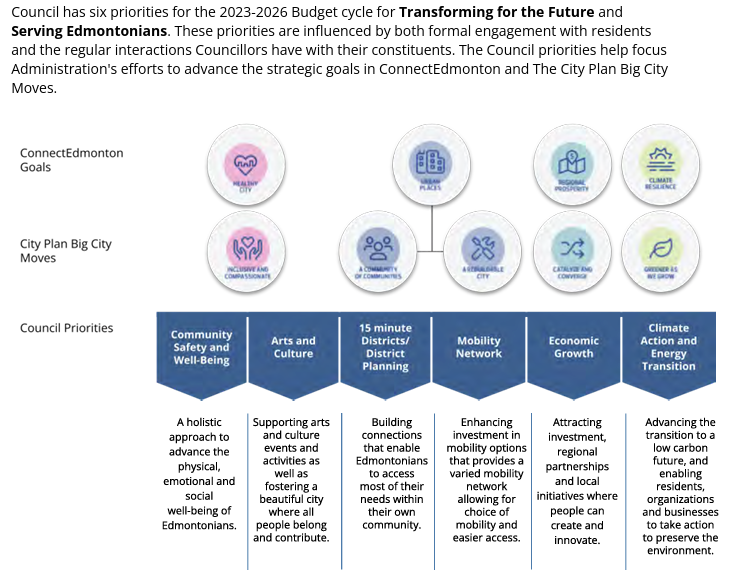
Screenshot from page 14 of the 2023-2026 Edmonton Capital budget, showing the six priorities: Community Safety and Well-Being, Arts and Culture, 15 Minute Districts/District Planning, Mobility Network, Economic Growth, and Climate Action and Energy Transition.  
https://www.gov.edmonton.ab.ca/sites/default/files/public-files/2023-2026CapitalBudget.pdf?cb=1750461215

I’m updating the original blog post now, in October of 2025, just after municipal elections in which we saw unprecidented intrusion by the provincial government into municipal affairs (eg: here, and here), thousands of political dollars donated to a new party hoping to ensure UCP aligned candidates were elected, and candidates who tried to cancel bike lanes and then used bike lanes as a dogwhistle to rally support to a regressive agenda. Despite the anti-bike, anti-15 Minute city, anti-infill rhetoric, political polling did not indicate bike lanes were actually an election issue. A Taproot poll early in the campaign cycle indicated that Edmontonians want a more walkable city, including ease of movement for all-season cylists and mobility-device users:

“For non-drivers, crossings are brutal for weeks on end,” a respondent said. “Bikers, without bike lanes, are left with few options beyond the sidewalks, but then are forced to make dangerous road crossings, as well, through four-to-six inches of mush. (I can’t imagine what the experience is like for people who use mobility devices).” (Gallant, The Pulse, Sept 25’25)

In the end, the majority of councillors elected or re-elected were those who support active transportation, 15 Minute city planning, densification and using municipal power to ensure well-being and housing for unhoused Edmontonians.

We even elected an all-season-cyclist as mayor!

That 2023-2026 Capital Budget that seemed so progressive will soon end. Planning for the next budget cycle (2027-2030) will likely start as soon as the new councillors are sworn in. It is therefore not too early to consider these questions:

  • Did we get the active transportation network that would allow for the city-wide, all-season, bicycle-as-transportation infrastructure that we needed?
  • What did the original $100M cover, and what still needs to be completed?
  • Will access to active transportation be equitable, so that all neighbourhoods have safe, accessible routes to ride to retail, schools, entertainment, etc.?
  • What do the residents outside the Henday (Edmonton’s ring highway system) need, so as to be able to choose bikes as transportation?
  • Have we, as a city, reduced our carbon footprint?
  • Are we going to meet our transition to low-carbon goals?

However those questions are answered, it’s pretty clear that wider circumstances –USA’s rogue attitude towards trade deals, persistence of the homelessness and opiod poisoning crises, intransigence of the provincial government– mean that money will be tight for 2026-2030. The next capital budget cycle will not be easy.There are many of our neighbours who bought the koolaid that active transportation and walkability are frivolous. Which means that perhaps a novel idea for policy that considers a new source of revenue, that incentivizes a greener, bicycle-savouring, property tax-stabilized municipal budget is not so madcap after all?

—————— ~~~~——————


Ok, bear with me; working through an idea.

The City of Edmonton’s urban and budgeting planners have estimated that to institute the bike transportation infrastructure needed to meet the city’s climate crisis, human well-being & municipal tax-affordability goals, would cost $200M (in 2022 dollars; make that $225 million in 2026?). It’s a very low price compared to other transportation infrastructure costs in the city’s budget.

But in the budget deliberations, only $100M was allocated for the 2023-2026 fiscal years.

So we have a shortfall of $100M over the 2023-2026 budget cycle (call it $120M for 2026).

Funding bike-transportation infrastructure is a smart move on city council’s part.

Car-dedicated infrastructure (roads, parking, parking lots, road maintenance machinery, etc.) is a huge part of a municipal budget, and no matter how much is budgeted, it is always inadequate: cities have learned that building roads induces demand for more traffic. It increases costs, risk, noise, and pollution rather than easing congestion or generating revenue. Car-infrastructure is ruinous for city budgets. Car-infrastructure is a disincentive to climate change mitigation. Car-infrastructure makes urban areas unpleasant. Taxpayers are never satisfied with what cities and municipal councils institute.

Bicycle infrastructure by contrast is cheaper to maintain. Bicycles don’t beat up the roads the way cars and trucks do. Bicycles don’t kick up particulates or create din the way cars do. Bicycle riders have better range of vision, fewer blind spots, than drivers, and they move at a slower speed, thus reducing collisions and dramatically reducing injuries and deaths. With bike transportation infrastructure, induced demand actually reduces risk, noise, pollution and costs to municipal budgets, and thereby to taxpayers.

So, it’s in a city budget maker’s best interest to encourage the increase of bicycle use while incentivizing decreases in car use. But funding 50% is like riding half a bicycle. Doable, not optimal. What are a city’s options?
In Canada, municipal legislation gives cities property taxes, bylaws & zoning as their tools. Fairly limited options. Municipalities may not, for example, impose extra taxes on drivers using certain neighbourhoods, the way UK & EU cities have done to reduce cars & incentivize public transit or bike use. Sadly, Canadian municipalities don’t have the lever that NYC does to reduce congestion and raise revenues.

But, WHAT IF the city used the prerogative over property taxation to assess a special “Climate Crisis Levy” on commercial properties dedicated to activities that enable car-use? WHAT IF the city dedicated all revenues from that extra levy to meeting the $100M-plus shortfall? 

Commercial properties, not residential properties. What kind of commercial properties? Low-hanging fruit are properties hosting gas stations, car dealerships, automotive repairs, auto-body shops, tire-sellers, vanity mufflers, car-washes, etc.

Of course, the property owners (landlords) would kvetch. Then they would pass on the levy-cost to the commercial operators leasing those properties. They, of course would raise their prices to their clientele, the citizens engaging in transportation choices that favour car-use, negatively impacting our environment, local quality of life, and collective municipal costs.

While building the piggy bank for the climate crisis-fighting infrastructure we need, ie: the missing $100+ million, the increased prices for car-fuel, car-repairs, etc, would create disincentive pressure on car use, whilst simultaneously ensuring the car-users pay (indirectly) for the costs they impose on the municipal budget. 

City council could vote to make such a special assessment temporary – eg, until the bike network/active transportation infrastructure project is completed & paid for. That’s how the province of British Columbia funded the Vancouver Airport upgrade- through a temporary levy on every traveller transiting YVR. Or council might not. City council might, for example, use the levy to pay for a bike network, then dedicate any surplus to neighbourhood renewal, community gardens, parks, e-bike subsidies, free bikes for refugees, bike-taxis for seniors’ residences, or any other climate crisis mitigation and improved urbanism measures they choose.

Would a city like Edmonton do this? Councillor Aaron Paquette generously responded to my original tweet thread and pointed out that while this mechanism would work IF a city was isolated, municipalities are not isolates and may be competing with neighbouring municipalities for commercial land rents. Municipalities are therefore leery of chasing away property tax paying commerce. However, I pointed out, in the middle term, it is unlikely businesses like gas stations or tire warehouses will accept the major expense of relocating their business across municipal boundaries – their customers are local, and the requirements for environmental cleanup after quitting a site are costly and complicated. It’s a better business decision to just pass on the cost. If, over the long term, those businesses decided to change their business model, shift away from serving car-users, or if property owners become more reluctant to lease their land to car-serving business, that’s actually a positive for the city, which should prefer urban commerce which enhances a net-zero, circular economy.

Would the ‘municipal isolation’ concern be a problem, really? Wouldn’t other municipalities see the benefit of such a mechanism too? Wouldn’t this be an opportunity for mayor-to-mayor leadership and solidarity? Yes. But as Councillor Paquette points out, the Province might intervene, and this intervention could be counter-productive. This has happened in Alberta; we’re expecting more of it. On the other hand, municipal mayors have stood in solidarity and cooperated in lobbying and negotiations with provincial authorities in other circumstances. It could happen again. As Anne Hidalgo demonstrated, a mayor can be threatened by the powerful, and she can stand “on the right side of the story”, and be vindicated by posterity.

What I like about this kind of solution is that it works subtly, to reduce the unrecognized subsidies municipal residents pay for drivers’ use of our tax-payer property-tax funded infrastructure, while funding the transition of our urban space without raising residential property taxes (making street parking un-free is a good idea too). It’s a polluter-pay mechanism, in which the ‘perverse incentive’ is one from which residents and the environment benefit, in the short-term as well as the long-term.

It would require a courageous, committed council, ready to incur the kvetchers’ temporary wrath. And let’s be clear -commercial property landlords are political campaign donors (if we didn’t know it in 2023, we certainly saw it in 2025). So yes, they have some influence. But their influence did not carry the 2025 election. So perhaps we have a window here, in the 2026-2030 budget cycle. It would also require visionary leaders, willing to work with their counterparts in other municipal and provincial offices, and with businesses to be impacted. Some of those businesses might decide to change their business model –gas stations for example could again serve bicycle users (that’s probably inevitable)– all for the greater good.

Councillor Paquette pointed out (in 2023) that there was (and I think, is even more, now), commitment on council. For example, they supported a motion from Councillor Salvador for an environmental fund. Paquette also opines that change occurs at the pace the electorate is comfortable with, no faster. Probably so. But I think we’ve seen in the 2025 election that electors will shift their thinking and their behaviours, as they hear new ideas, and experience new opportunities. Our new mayor, Andrew Knack, was not a bicycle commuter when he first was elected. To his credit, he accepted an invitation from some bike commuters, who showed him what cycling in the city was like, and he changed his view! Parisian mayor Anne Hidalgo demonstrated that social change –modal shift– is possible when she pushed for a dramatic shift to bike lanes for Paris. Research by urbanists and transportation engineers show transition from motornormative, car-default urban-infrastructure can be swift, where people speak up, and political authorities risk bold decisions. Amsterdam is the obvious example. But Oulu, in northern Finland, might be a better comparator for Edmonton. In Oulu, political decisions led to an extensive bike-transportation network of routes that are maintained all seasons, making Oulu the winterbiking capital of the world. That is, perhaps a better example for a city with one quarter of the year where snow and ice can impact cycling. Although, with climate change, Edmonton winters are seeming damper, so perhaps Copenhagen would be an example to emulate.

I don’t really think Edmonton’s council would ever create such a levy. The point is, Edmonton’s city councillors have a mandate to be more all-season, all-riders, all neighbourhoods, bicycle-as-transportation-friendly. So let’s make Edmonton the Amsterdam-Copenhagen-Oulu-Paris of Canada.

Urbanists, teachers, parents and municipal councillors must read Tim Gill’s “Urban Playground: How Child-Friendly Planning and Design Can Save Cities”

Have you heard of “The Socialist Ten Commandments”?

The Future of Knowledge Mobilization and Public History Online: Supplementary Reading

In August 2024 representatives from multiple online history projects, universities, and public history institutions met in London to discuss key topics in online knowledge mobilization. Over the next several months attendees will publish essays reflecting on the topics we discussed. In the meantime, here are some open-access resources that intersect with workshop content.

The Future of Knowledge Mobilization and Public History Online: Supplementary Reading

The Flygskam Scam

In reading and thinking about my eco-anxiety, I’ve recently learned of a Swedish neologism that describes a new way of thinking about air travel: flygskam: flight guilt. I expect that like hygge, flygskam will soon be a part of the English lexicon. Because so many of us have eco-anxiety. Which is definitely not hygge.


Flygskam

Flygskam :: Flight guilt 

 
Back when I was teaching my Theory in Anthropology courses it was challenging but not impossible, in the early 90s, to get students to imagine a society where the rules of capitalism did not pervade *all* actions, choices, perspectives. World systems theorists  from the late ’70s (eg: Emmanuel Wallerstein and Jane Schneider) and ethnographies from Oceania helped enormously, as did my own insights from participant observation and research in Tonga. But by the ’00s, it became harder and harder to get students to that place of intellectual flexibility required to recognize other, non-capitalist social systems, other social-economic formations, as viable, as really real.  While the originally contested concept of ‘culture’ as constructed by anthropologists became so mainstream that I could spend less time teaching what ‘culture’ was, recognition that non-capitalist relations to the environment and other species did exist became harder and harder to achieve. Maybe I became a poorer professor, but for me, students struggled more and more to think without capitalism as the default for society.
It is axiomatic in anthropological theory that it is difficult to ‘see’ [think\imagine] without one’s cultural lens affecting one’ perceptions. That axiom is the core of the participant-observation methodology, the idea that living as others live provides an avenue for seeing and thinking with a different cultural world view, leading to an appreciation and valuing of differences and  possibilities for critiquing one’s own status quo. The method works. 
But, as globalization pushed, and capitalism –as neoliberalism– achieved further, wider, deeper, capillary and rhizomic relations, I struggled to find ways to describe social formation alternatives to capitalism that didn’t sound to students like othering of indigenous peoples, or romanticized history, or science fiction. Despite my commitment to the ethnographic method, and Paul Mason’s work on post-capitalism aside, it seems to me now that literature –Ursula K. LeGuin, Margaret Atwood, Octavia Butler– is possibly the best avenue for reflecting on alternatives to a capitalist mode of ecosystem-destruction relations, simply because globalization and neoliberalism has completed the colonial plot. There are no contemporary sample societies to point to as unaffected, materially and culturally –not my beloved Tonga– by capitalist modes of production, by what Greta Thunberg neatly described as “fairy-tales of eternal economic growth“. Not even the famously xenophobic Sentinalese of the Andaman Islands are unaffected. Else why would they have the highly effective defense system that resulted in a wanna-be missionary’s death?
 
Eco-anxiety abounds, even among those who do not recognize they have it. It constantly surprises me that so many people think rivers are for viewing, maybe boating on, maybe fishing from, on the right day, in the right place (but catch and release or beware of how many you eat; avoid the belly fat, where the heavy metals concentrate). The default thinking of a river is not as something to drink. Unless with filters and purification tablets. Or in an emergency. It wasn’t always like this. I have lived with, I remember, environmental beauty appreciated via sight, smell, sound, feel, and yes, taste; without eco-anxiety. 
 
This is what I’m pondering, with my 3:30AM jetlagged brain, as I read Naomi Klein saying: “the fact that for so many people it’s so much more comfortable to talk about our own personal consumption, than to talk about systemic change, is a product of neoliberalism, that we have been trained to see ourselves as consumers first”.
 
Winter is here, but I can’t be hygge because I have flygskam. But my flygskam is not really a product –in the foucauldian sense– of my eco-anxiety. My flygskam is an indicator, evidence of another axiom: that capitalism atomizes. It induces us to think and respond and benefit as lone individuals, not as interconnected members of a system.  Capitalism works,  insidiously, to disguise it’s own capillary power, and to normalize those who control the capital that influences the global political, economic and social options and actions that are causing the climate crisis (while also exacerbating racism, sexism, poverty, disparity, war, alienation of indigenous lands, etcetera). I’m supposed to feel my flygskam on my own, rather than notice the scam, and scammers, that it signifies. That’s the capitalism mode. 
 
Is there a Swedish (or Sentinalese, maybe?) word for the anger I feel towards those who are blocking the systemic changes we all need to preserve this planet’s ecosystem? I want it; need it. 
November 12, 2019.
Some interesting links:
Capitalism:
Mason, Paul [2015] PostCapitalism: A Guide to our Future. Wikipedia summary: https://en.wikipedia.org/wiki/PostCapitalism:_A_Guide_to_Our_Future
Schneider, Jane [1977] “Was There A Pre-Capitalist World-system?” Peasant Studies 6:1:20–29.  Find it here: https://www.irows.ucr.edu/cd/books/c-p/chap2.htm
Wallerstein, Immanuel [1974] The Modern World-System, Vol. 1: Capitalist Agriculture and the Origins of the European World-Economy in the Sixteenth Century. New York: Academic Press.
Ethnographies:
Burawawoy, Michael [1979] Manufacturing Consent: Changes in the Labor Process under Monopoly Capitalism. University of Chicago Press
Weiner, Annette B.  [1979] Women of Value, Men of Renown : New Perspectives in Trobriand Exchange. University of Texas Press
Hygge:

Failing The Moral Test: Canadians Must Redress Our Nation’s Abuse Of Children

the moral test of government is how that government treats those who are in the dawn of life, the children*

On Valentine’s Day, 2017, Justice Edward Belobaba of the Ontario Supreme Court ruled that the Canadian government breached agreements and failed in its responsibility to indigenous peoples, for its part in a child-welfare program that saw thousands of Ontario’s children removed from their parents, communities and cultures. Now referred to as the “Sixties Scoop”, between 1965 and 1984 some 16,000 children deemed by provincial social workers to be ‘at risk’ were apprehended from their parents and communities, then fostered or legally adopted by non-indigenous families. The Ontario protocols became the template for other provinces, ramifying indigenous families’ distress across the country. In many, possibly most, cases the parents who had their children apprehended were themselves victims of a prior form of state-sanctioned kidnapping and enfranchisement: the residential school system. If the parents were not themselves survivors of residential schools, perhaps suffering the now-recognized symptoms of PTSD or abandonment trauma, they were likely subject to poverty, poor education, underemployment, and the generalized public discrimination and ‘anti-Native’ racism that was the default in mainstream society until very recently.

During the Sixties Scoop, even if a social worker was not stigmatizing indigenous parents and children, and was trying to apply child welfare guidelines evenly to all cases requiring intervention, the parenting assumptions penalized at the very least poverty and denigrated non-European (WASP) traditional practices. Consider these scenarios: A mother of English or French or German ancestry could buy Woodward’s Gripe Water fromgripe-water the local pharmacist and use it to sooth her cranky infant. A mother of Cree, Mohawk or Anishnaabe ancestry who made a tisane including dill or fennel, sugar, baking soda, and watered gin could be accused of providing alcohol to a minor, be declared unfit as a parent, and have her child removed. Yet commercial preparations of gripe water had an alcohol content ranging from 3.6% to as high as 9%, even into the early 1980s (Blumenthal, 2000). A case of domestic abuse with a white family would see the police either ignore a woman’s complaints and leave her and her children with the abuser, or help them get to a shelter; with an indigenous family, it could lead to seizure and permanent removal of the children from their entire extended kindred.

It was the mundane level of hypocrisy, the willingness to assume that indigenous cultures’ parenting practices were by default inadequate and dangerous relative to ‘modern’ mainstream (a.k.a. white) society, and the wider implications and ironies of that attitude, that spurred me to write the following letter, in 1998, to Michael Enright and Avril Benoit of CBC Radio’s This Morning:

Date: Mon, 23 Mar 1998

To: thismorning@cbc.toronto.ca
Subject: Spock’s influence

As a mother and a social anthropologist specializing in mothering and the influences of North American medical personnel in everyday life, I listened with interest to your panel of four mothers discussing their use (and non‑use) of Benjamin Spock’s Baby and Child Care [originally published 1946]. Sheila Kitzenger and Sherry Thurren were also interesting, especially in their discussions of the context of maternal advice at the time that Spock was writing: his book was indeed a revolution for its time, in that it confirmed a mother’s abilities to handle situations, and advised a less regimented, disciplinary form of baby care, with more expressive loving from parents. However, the one question I kept expecting to come up was never asked:  “When everyone else in the medical establishment was advocating discipline, routine, formula over breast-milk, and telling mothers that they needed a doctor’s advice for all aspects of an infant’s care, where did Benjamin Spock get his path-breaking ideas?”
The answer would have been somewhat surprising, certainly to the thousands of American and Canadian families who do not know that the revolutionary child care advice they faithfully followed, and thought of as resulting from North American medical scientific breakthroughs, was in fact heavily modelled upon Polynesian and other First Nations’ child rearing practices. Benjamin Spock’s ideas came out of anthropology, not medicine.
Benjamin Spock was the pediatrician to the famous anthropologists Margaret Mead, Gregory Bateson and their daughter Mary Catherine. As your listeners may know, Margaret Mead’s first book, Coming of Age in Samoa [1928], focused on child rearing in Polynesia. She later did similar research in North America and other parts of the Pacific as well. Mead was tremendously influential in areas of social policy in the USA from 1928 to after WWII, but not all of that influence was overt. As her daughter later wrote about Mead: “Margaret’s ideas influenced the rearing of countless children, not only through her own writings but through the writings of Benjamin Spock, who was my pediatrician and for whom I was the first breastfed and self‑demand’ baby he had encountered” [from With A Daughter’s Eye, 1984, William Morrow & Company, Inc].
It is ironic that the great influence aboriginal peoples have had in contemporary North American cultural and medical practice has been so disguised. But there is an even greater irony here:  while at least two generations of white, middle class parents were following re‑packaged aboriginal people’s parenting practices and choosing to nurture and indulge their children for the sake of their good psychological development, First Nations parents were being forced to send their children away to residential schools: There, aboriginal children were subjected to the very discipline, authority and cold regimentation that Mead and Spock helped to discredit.
And we now have the temerity to ask why so much psychological damage is rampant in some First Nations communities, and how is it our concern!

sincerely,
Heather Young Leslie

I wish I had been more forceful in my 1998 letter. I wish I had spoken of racism, tragedy and abuse rather than ironies. At the time, I feared a more candid letter would not be read on air. It has taken so long for an appetite for the truth about generations of Canadian state-sponsored violence against children and families to come into the general discourse (even now, I suspect it is only the liberal-Canadian public who are paying attention). When Justice Belobaba agreed with the complainants that the Sixties Scoop resulted in widespread psychological traumas for the children, their extended families and communities, leading to psychiatric disorders, unemployment, violence,  incarceration and suicide, he was affirming what Indigenous-rights activists have been saying for a very long time, often to deaf or uncaring ears. Yet beyond the thousands of individuals, mostly children, harmed, entire Indigenous nations have suffered as generation after generation lost fluency in their languages, ability with ceremony, technical making and survival skills, intimacy with traditional territories and kinship networks; many simply died. Colonialism and colonization is war that never stops killing.

Although Canada as a nation has engaged with the recent Truth and Reconciliation Commission‘s investigation of the residential school system, and now publicly seeks ‘reconciliation’ with Indigenous peoples of Canada, and while our Prime Minister has promised to honour treaties and enact a ‘nation-to-nation’ relationship, there is much that has yet to happen before true reconciliation can happen.  While Carolyn Bennett, the current federal Minister of Indigenous and Northern Affairs, has publicly stated that the federal government will not appeal Justice Belobaba’s ruling, her Ministry has spent millions vigorously applying every loophole they could to refute another child welfare case, this one brought to the Canadian Human Rights Tribunal, regarding the Government of Canada’s deliberate unfunding and policy blocking of First Nations Child and Family Services. The Tribunal’s Decision was that Canada, via the Ministry of Indigenous and Northern Affairs, is purposefully discriminating against “163,000  First  Nations children  and  their   families   by  providing  flawed  and  inequitable  child  welfare services to  First  Nations  children and by allowing  jurisdictional  disputes  between and within governments to cause First Nations children to be denied  or experience delays  when  seeking  to  access  essential  government  services available  to  other children“. Despite claiming to welcome the Tribunal’s Decision of January 26 2016, Carolyn Bennett’s Ministry continues as of Feb 2017, to be non-compliant with the legally-binding ruling of the Tribunal. Further, she is speaking about trying to avoid a court-mandated settlement in the Sixties Scoop class action. The 16,000 complainants have requested damages of $85,000 each, less than one year’s middle-class salary, for a total of $1.3B. Prime Minister Justin Trudeau’s Cabinet and Finance Minister Bill Morneau have not, as yet, prioritized indigenous reconciliation and fair costs for federal responsibilities in the budget for 2017. 

Most Canadians do not know we are all “Treaty People“, nor how much has been taken from our treaty-partners, how much loss, pain and trauma still reverberates, though I think most people can empathize with having a grandparent or spouse with PTSD, with the fear of loosing one’s home, or the horror at the mere idea of having a child kidnapped, disappear, or commit suicide. While there is much resilience and goodwill within Canada’s Indigenous communities, there is much understandable anger and resentment too. The solution goes beyond the political will to admit wrong-doing, apologize and budget the true costs of complying with historic treaties and Supreme Courts’ and Human Rights Tribunal findings, though those are essential measures. There is reaching out by everyday Canadians to be done too.  A good place to begin is to learn what it is we don’t know: even those who say they are allies of Indigenous peoples, are supportive of the reconciliation cause, or are anti-racist, can learn more, and should.  This is a scenario where what you don’t know can hurt someone, probably a child and or her/his family.

I have three recommendations to start you off: The first is that all Canadians, young and old, multi-generational settler-descendent to first generation immigrant to refugee, read the Truth and Reconciliation Commission’s  reports, especially their Calls to Action. The second is to view the National Film Board‘s We Can’t Make the Same Mistake Twice, Alanis Obomsawin’s latest documentary, which follows and makes easy to understand, the many-years history of the Human Rights Tribunal’s hearings and eventual findings. The third is to take the University of Alberta’s online course Indigenous Canada (enrolment begins March 2017; it’s free to audit, cheap to get a certificate). These are things that Community Leagues, Rotarians, Lion’s Clubs and other service organizations, book clubs, walking and yoga groups, church parishes, curling and hockey and baseball teams can do together. These are easy initial steps to reconciliation that all non-Indigenous Canadians can, and should, take.

That’s not the end of course. We all must know and agree to respect the Treaties that the nation-state of Canada is built on; learn what is in the treaties governing where we live now and where we were born (if there even is a treaty), lobby our provincial and federal governments to stop asking First Nations for just a bit more of their land, water  and wildlife habitat. A “nation-to-nation” relationship is like consenting to sex: “no” must be respected; it doesn’t mean “Try harder to convince me” or “If you say no, we’ll just take it”.  In general, we must be mindful of the place we inhabit, and what impact our actions have on our treaty partners, wherever we live. This is going to be tough for those who have benefited from privilege and not had to recognize treaty responsibilities, certainly. Reconciliation is a long, slow, multi-party process. It requires so much more than “I’m sorry”.  Now is the time for the non-indigenous peoples of Canada to paddle the boat. Because, to recycle a saying from my youth: “If you’re not part of the solution, you’re part of the problem”** and this problem is one that persists in abusing children and their families. That’s not what we mean when we proudly exclaim our “Canadian values”.


*Hubert Humphrey. Remarks at the dedication of the Hubert H. Humphrey Building, November 1, 1977.
**Eldridge Cleaver. Presidential candidate speech at UCLA, April 10, 1968 (Listen at 51:05 mins), also speech to the San Francisco Barristers’ Club, September 1968.

The Lost Jingle Dress

img_2031-1The Lost Jingle Dress is my first ‘published’ piece of creative nonfiction. The story lauds the small, tight-knit community of Jasper, Alberta. I wrote it in 2014, and it was performed by Stuart McLean in 2016 for the CBC Radio program Vinyl Café. It aired in the story exchange segment of the “Indigenous Music” episode of June 3 & 4, 2016.

Stuart McLean’s performance of The Lost Jingle Dress is archived in the Education and Research Archive of the University of Alberta’s Libraries, here. Forgive the amateurish sound production. This version was recorded from the public radio broadcast onto a private-owned iphone 5 in m4a format.


To Follow or Not; Paying Attention to the Ghomeshi Trial

I’ve been resisting following the Ghomeshi trial. Partly, I’m enabled by circumstance–a temporary fragility of anato Continue reading

December 6, 1986 & 2015: The Resilience of Violence

26 years ago today; I was pregnant, happy, optimistic for my child, who was being born into a world that had just breached the Berlin Wall. It seemed like peace was breaking out all over. And then, Dec 6. Montreal. L’Ecole Polytechnic.

It was a terrible shock. Not just that a single shooter would attack students at a university. But that he would specifically order classes to separate into groups of male and female, and then shoot, murder, slaughter, the women only. And then repeat in other classes.

Suddenly, the entire nation, was confronted with a terrible truth: as people listened to the reports, some realized they’d expected -and accepted- the idea that the shooter might separate the victims by sex, so that he could shoot the men. That he targeted the woman was a surprise, an affront.

The tragedy of L’Ecole Polytechnic gave Canadians a double shock: We realized our attitudes to violence had been blunted by patriarchal assumptions that included the horrid acceptance that males were legitimate targets for violence. Equally, our understanding of violence against women had been dismally, willfully, complicitly, naive. The value of feminism as a necessity, even as it was being described as the murderer’s motivation, was confirmed.  The optimism of Berlin was washed in the horrors, the guilty insights, of Montreal. 22 days later, I gave birth to a daughter.

Now, 26 years on, we have raised the approbation of Violence Against Women to iconic, professionalized status. It is possible to use the acronym of VAW and be widely understood as one condemns patriarchy, the ubiquitous and resilient inequities between sexes, and argues for services, policies, legislation, education to mitigate VAW. Good steps have been taken. But not enough.

The acceptance of violence itself has not moved on much from the guilty horror of 1986, and mothers’ children continue to be slaughtered. Today, as every Dec 6, I condemn the craven decisions that permit the means for violence; I mourn for those mothers who suffer the catastrophe of violence against their child, and offer a grateful whew to the luck goddess that I am not in their cohort.